
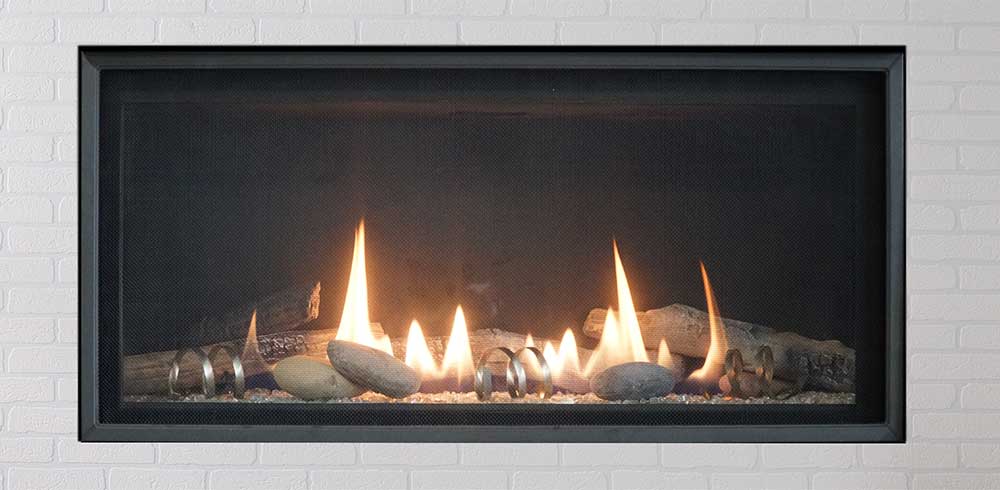
Fireplace accessories can make your fireplace easier to use, help circulate warm air, or give your hearth a finished look. The right choices depend on your fireplace’s fuel type, model, and the improvements you want to make. A wood-burning fireplace may benefit from tools and a properly fitted grate, while a compatible gas fireplace may offer options for a blower, decorative media, or remote control.
Explore our selection of fireplace accessories to customize your setup. Before buying, check whether each accessory is approved for your fireplace. Physical fit alone does not establish compatibility.
How to Choose Fireplace Accessories
Start by deciding what you want the accessory to accomplish. Are you looking for easier fire tending, better warm-air circulation, a different flame presentation, or a decorative update? Separating practical needs from style preferences makes it easier to prioritize your purchase.
- Identify your fireplace: Have the manufacturer, model number, and fuel type available when shopping for fitted components.
- Review compatibility: Blowers, fronts, media, controls, and other installed accessories may be designed for specific appliances.
- Measure the installation area: Check the dimensions relevant to the accessory, including tapered firebox walls, hearth space, and mantel projection.
- Check installation requirements: Electrical connections, gas components, mounting hardware, and combustible clearances require more consideration than a freestanding decorative accessory.
- Follow the applicable instructions: Use the fireplace and accessory documentation to confirm placement, installation, and operating requirements.
Fireplace Blower Kits
A compatible fireplace blower kit helps move heated air from the fireplace’s circulation passages into the room. It can be a useful addition when you want more active air circulation from a fireplace designed to accept one.
Choose a blower by its approved application first. Housing dimensions, mounting arrangement, electrical requirements, and control connections all need to match your fireplace. A higher airflow rating does not make an incompatible blower a suitable upgrade.
Depending on the kit, controls may include variable fan speed or a temperature-activated switch that starts the blower after the fireplace warms up. Check what is included, how the fan operates, and whether additional controls are required. Allowing access for cleaning and service is another consideration when comparing options.
A blower should not be selected solely by room size, and improved air circulation does not guarantee a particular reduction in heating costs. Have electrical installation or compatibility questions reviewed by a qualified professional.
Fireplace Tools, Fire Starters, and Log Lighters
For a wood-burning fireplace, a tool set keeps common fire-tending and cleanup tools together. Depending on the set, you may find a poker for repositioning wood, tongs for handling logs, and a brush and shovel for hearth cleanup. Compare tool length, handle comfort, stand stability, and the space available beside your fireplace.
Fire starters and gas log lighters serve different purposes. A fire starter helps ignite a wood fire, while a gas log lighter is an installed gas component used to help light wood in a suitable fireplace. Neither should be selected without checking its intended application.
Use only fire-starting products permitted by your fireplace instructions. A gas log lighter requires compatible equipment and proper gas installation; it should not be treated as a decorative accessory or a substitute for a gas log burner system.
Fireplace Grates and Log Retainers
A fireplace grate supports burning wood above the firebox floor in fireplaces designed for grate use. Its shape affects how it holds logs and collects the developing coal bed. A log retainer helps keep logs positioned as they burn and settle, but it does not replace a fireplace screen.
When comparing fireplace grates and retainers, consider the following:
- Firebox shape: Measure the front width, rear width, and depth. A tapered firebox can limit which grate shapes fit.
- Construction: Compare cast iron or steel construction, bar thickness, and support design in relation to your burning habits.
- Log support: Look at basket depth, bar spacing, and raised edges to understand how the grate holds your usual firewood.
- Required space: Leave the clearances specified for the fireplace and grate rather than choosing the largest frame that physically fits.
Some appliances require their original grate or a specified replacement. Do not substitute a generic wood grate for the grate supplied with a gas log set or another appliance-specific assembly.
Fireplace Firebacks
A fireplace fireback sits behind the fire and can add a decorative backdrop to a suitable fireplace. Cast iron firebacks absorb heat during a fire and release stored heat as they cool. Their appearance can also complement a traditional grate, screen, and tool set.
Check the usable rear-wall width, available height, firebox depth, and any required support feet before choosing a fireback. Its placement must not interfere with the fireplace’s venting path, burner arrangement, or required clearances.
Compatibility is especially important with gas log sets and factory-built fireplaces. Add a fireback only where the applicable fireplace, burner, and fireback instructions permit it. Follow the product’s positioning and support requirements rather than assuming every plate uses the same air gap or mounting method.
A fireback is an accessory, not a repair for cracked, deteriorating, or otherwise damaged firebox masonry. Have existing damage evaluated before continuing to use the fireplace.
Decorative Media and Fireplace Enhancements
Fireplace enhancements can change the appearance of your fire feature without changing the surrounding room. Depending on the appliance, options may include approved decorative logs, fire glass, stones, ceramic shapes, or other finishing components.
Choose media by compatibility before color or style. A burner designed for a particular log arrangement is not automatically suitable for fire glass, and decorative pieces should not be added simply because they withstand heat.
Media type, quantity, and placement can affect burner operation. Follow the specified arrangement around burner ports, pilot assemblies, and other components. For replacement panels, trim, or surrounds, match the accessory to the fireplace model and approved installation configuration.
Fireplace Screens and Fronts
Fireplace screens and fronts combine appearance with functions that vary by product. A freestanding mesh screen for an open wood-burning fireplace helps contain sparks and embers. A fitted decorative front changes the appliance’s appearance, while a manufacturer-specified safety barrier helps reduce accidental contact with hot glass.
These products are not interchangeable. A decorative front is not necessarily a spark screen, and a freestanding screen does not replace a required appliance barrier.
For a freestanding screen, compare coverage, stability, panel configuration, and access for tending the fire. Measure according to the screen manufacturer’s sizing instructions. For fitted fronts, doors, and barriers, confirm the exact fireplace model and approved part.
Glass, metal fronts, and screens can become hot during operation. Keep children and pets away, maintain the fireplace’s required clearances, and follow the operating instructions for any doors or barriers.
Fireplace Mantels
A fireplace mantel frames the fireplace and helps connect it to the rest of the room. A shelf offers a simpler accent, while a full surround creates a more defined architectural feature.
Compare overall width, shelf depth, material, finish, and mounting requirements. Look beyond whether the mantel fits the wall: combustible materials must also meet the clearance requirements for your fireplace and installation.
Mantel projection can affect the required distance above the fireplace opening. Follow the applicable clearance diagrams instead of using a single spacing rule for every fireplace. Mounting hardware and wall support must also suit the mantel’s weight and intended display load.
If a television is part of your plan, review both the fireplace and television manufacturer’s requirements. A mantel shelf alone does not establish that the space above it is suitable for electronics.
Fireplace Remote Controls
A compatible fireplace remote control can make everyday operation more convenient. Depending on the fireplace and control system, available functions may include on/off operation, temperature control, or additional adjustments.
Match the remote and receiver to the appliance’s control system rather than choosing by appearance or features alone. Not every remote supports every fireplace, and adding a remote does not automatically add flame adjustment, fan control, or electronic ignition.
Frequently Asked Questions
Are fireplace accessories universal?
No. Blowers, remotes, decorative media, fronts, and other fitted components often require specific fireplace compatibility. Even freestanding accessories must suit the available space and the fireplace’s operating requirements.
Can I add a blower to my existing fireplace?
Only if your fireplace supports an approved blower kit. Check the fireplace model, available installation space, electrical requirements, and compatible controls before purchasing.
Can I replace gas logs with fire glass?
Not unless the fireplace or burner manufacturer specifically permits that conversion. Logs and fire glass require compatible burner designs and placement instructions; they are not interchangeable decorative materials.
What accessories should I consider for a wood-burning fireplace?
Depending on the fireplace, useful accessories may include a suitable screen, fire-tending tools, an approved grate, and fire-starting supplies. Check the fireplace instructions first, since some appliances require specific components or prohibit certain additions.
Can I add a fireback to a gas fireplace?
Only where the fireplace, gas log system, and fireback instructions permit it. Confirm that the addition will not interfere with burner placement, clearances, or venting. Physical fit alone does not confirm compatibility.
Final Thoughts
The best fireplace accessories serve a clear purpose and work with the fireplace you own. Start with the components needed for proper operation, then consider upgrades for convenience, air circulation, and appearance.
Need help narrowing down your options? Contact our fireplace experts with your fireplace model, measurements, and project goals for help selecting compatible accessories.